
| |
|
#1
 09-29-2011, 10:42 PM
|
|||
|
|||
 Sound Spike Interview
Q&A: Lindsey Buckingham
http://www.soundspike.com/features/t...ey-buckingham/ Story by Christina Fuoco-Karasinski SoundSpike Contributor Published September 29, 2011 06:50 AM Guitarist Lindsey Buckingham was one of the forces behind one of rock's most legendary records, Fleetwood Mac's "Rumours." But the singer/songwriter, Grammy winner, producer and Rock and Roll Hall of Famer sees his latest solo effort, "Seeds We Sow," as his best work yet. "The funny thing is, I was not planning on doing this," Buckingham said about "Seeds We Sow." "If you go back to 'Under the Skin' and 'Gift of Screws,' which were back-to-back albums, I really had an agenda to do that. I'd been trying to get sort of some momentum on solo work for a long time. At that point, I had to actually say to Fleetwood Mac, 'Don't bother me for three years; I'm going to do this.' "This time, Fleetwood Mac got off the road. I was not planning on making an album; the time opened up and I filled it. I think, probably because it was way more offhand, it surprised me how well it turned out. I was very pleased when I got to the end. Two things: One, because there was no regal preconception of what I was going to do going in, and all the material was fresh and pretty much written off the cuff as I made the album. But also it was, probably to some degree, the culmination of all I've learned during solo work and then bringing it back into Fleetwood Mac over the last eight years or so. It feels like the culmination of something." After Buckingham moved to Los Angeles in 1973 with then-girlfriend Stevie Nicks, the couple signed to Polydor Records and released the "Buckingham Nicks" album. The two joined Fleetwood Mac on New Year's Eve of 1974, and the band's self-titled album was released in 1975. The collection was a hit, but it did not compare to the success of 1977's "Rumors," which has gone on to become one of the best selling albums of all time (even re-appearing on the Billboard Top 40 in 2011 after the "Glee" episode paid tribute to the album). Buckingham's first solo album, 1981's "Law and Order," produced "Trouble." His subsequent solo efforts, 1984's "Go Insane," 1992's "Out of the Cradle," 2006's "Under the Skin" and 2008's "Live at the Bass Performance Hall" and "Gift of Screws," have all earned critical acclaim. He was recently honored with ASCAP's Golden Note Award, and has also received The Les Paul Award. Buckingham spoke to SoundSpike about his current solo tour, the making of "Seeds We Sow" and what he feels is his greatest accomplishment. SoundSpike: Your solo tour seems like it would be fun. Lindsey Buckingham: The solo tours, especially, because the whole approach to putting the show together is a little more meticulous, a little more esoteric. I really have a lot of fun doing this. What can we expect from the tour? I'm doing quite a few songs just by myself, just with a guitar. I have three other guys that come out and we do a bunch of ensemble stuff, and cover a lot of ground as a four piece. We're doing seven new songs. We start out the set with just me, then they come out and we run through quite a few new songs. They'd probably run me out on a rail if there weren't a few jams in there, so we're doing "Tusk ," "I'm So Afraid." A couple of Fleetwood Mac things in there. It's mainly new approach kind of stuff. Would you call it a retrospective of your career? A retrospective. Well, I mean, you know, the more material you have to draw from, the more you can certainly draw from that range. You tend to want to use your assets, whatever they are. If you wanted to use that term, you could say there's been certainly years of material to draw from for quite awhile now. It's way less of a retrospective of my career than a Fleetwood Mac tour. The thing about a Fleetwood Mac tour, and you come to terms with this, is that no one is really that interested in hearing anything new. There's a freedom you get when you do come to terms with that. Then it's really about what you do with what you got. The good thing about the road that I've been able to travel is that I do have that big machine, and then I have the small machine of solo work. That's what keeps me aspiring to be an artist and keeps me taking risks, and keeps me in touch with my ideals and aspiring to be an artist in the long term. That's where the growth is, is with the small projects and I think the show reflects that. "Seeds We Sow" is your sixth solo collection, but your first self-released effort. Was it freeing to do that? It's very funny. I can go back to the very first solo album I ever did and all the previous solo albums have been on Warner Bros. Warner Bros. never really got behind the solo work. They always kind of drew a blank. I think they always were thinking, "Well this is nice, but let's get back to what's really important." That sort of got more and more defined as the model of the large label became increasingly in distress. The funny thing about leading up to the decision to put this album out ourselves is I did make contact with Warner Bros. My deal had expired. A friend of mine, Rob Cavallo, who's a producer and someone I've known for a long time, he was given this new position over there. He was touting how he was going to change the company. I thought, "Well, OK, that's cool. Make it an artist company again." He heard my album and when I talked to him about it, I realized, in fact, the company had changed him in that position. He started talking to me about what he had to make on a quarterly basis. I thought that's the end of that. So it was just like the final defining factor in terms of not wanting to be on a large label. I talked to Daniel Glass [from Glassnote] and we talked to a few other people who have independent labels. But Irving Azoff, who is my manager, he and I decided we could do all of that ourselves. That's what kind of led up to it. It couldn't do any worse than what Warners was doing. The last two solo albums that I put out -- which were about four or five years ago, back to back -- they didn't do a damn thing for them. So, I mean, we'll see. Having said that, these are small projects. They are esoteric projects. They're not mainstream. They're not meant for the same number of ears. The people who are interested in this album and want to hear it will find it one way or another. How do you feel your album fits in your solo catalog? I think, you could look at the last two and say they were more conceptual. One really held the line in terms of being very acoustic. The other one was a lot of tracks that had been waiting to find a home for awhile. Mick [Fleetwood] and John [McVie] had been on a lot of those. It was a little more haphazard. It was probably more the kind of album that maybe we wanted because it sounded more like Fleetwood Mac. This album, it feels more like an album I did back in the '90s, "Out of the Cradle." It feels like me. I played pretty much everything on it. I engineered it. I mixed it. We're putting it out ourselves. It feels like it has a resonance with my personal life, which has been greatly enriched over the last 10 or so years, having a family for the first time. I don't know. A lot of things seemed to have kicked in on this album. It feels like that I reached a certain point of maturity. Finding my center, which of course, is the guitar. Lyrically, it's the best work I've ever done because I think the lyrics have gotten ... not a lot more poetic necessarily but a little more open to interpretation, a bit of a Rorschach for whoever's listening to them -- including me. Sometimes I don't know what I'm saying until I throw little lines around and then it takes on a certain meaning. I think the process was really a valid process this time, and I think the outcome reflects that. What do you consider the greatest accomplishment of your music career? I would say the thing that I'm the most proud of -- if you want to look at it as an overview and the whole arc of a career -- is that I would say probably a lot of people who have been doing this as long as I have, they haven't maintained their ideals in the same way. What happens when you experience a certain level of commercial success, this axiom kind of tends to kick in which is a business axiom. It's not peculiar to the music business, it's about defining the brand. Let's define the brand, let's find the formula of the brand, let's stick to the brand, let's use that formula until it's used up and then let's move on. It's a great formula for business. It's not a great formula for aspiring to be an artist in the long term. On the heels of "Rumours" back in the late '70s, we were certainly poised to paint ourselves into a corner. We were poised to make "Rumours 2." Of course, I kind of drew a line in the sand back then and we made this album called "Tusk," which was a complete left turn. It kind of defined the way I still think today, which is to take those chances, try to undermine the business model whenever you can to try to remember who you are and why you got into this business in the first place. Music has a transcendence to it. It should, anyway. The idea of making it and sharing it should have a religious connotation. You can keep yourself on a certain plane if you remember certain things to do and more importantly certain things not to do. I think I've somehow managed to walk this road where you've got the big machine on the one side and the small machine on the other side. If it were a movie maker, it would be someone who makes mainstream films but then goes off and does independent films He would probably tell you that it's the independent films where he gets his growth and his religion and his ability to take risks. There is no brand to uphold. There's nothing that defines what has to be done for commercial reasons alone, which is a lot of what is wrong. Especially in today's business, you see so much of this from the top down. Things need to be from the bottom up. I think I've managed to live simultaneously in both of these words pretty effectively. I think I'm pretty proud of that. 
|
| . |
|
|

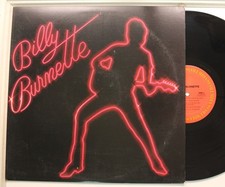
Billy Burnette Lp Self Titled On Columbia - Vg+ To Vg++ / Vg++
$11.99
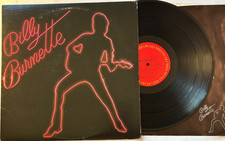
Billy Burnette - Self-Titled LP - 1980 1st Pressing 12" Columbia LP + Lyrics VG+
$4.50
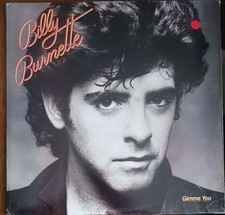
BILLY BURNETTE - GIMME YOU - 1981 COLUMBIA RECORDS VINYL ALBUM - (VG/VG+)
$5.00
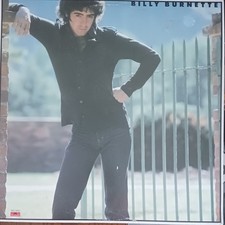
BILLY BURNETTE - (SELF- TITLED) - 1979 POLYDOR RECORDS PROMO VINYL LP - (VG/VG)
$5.50
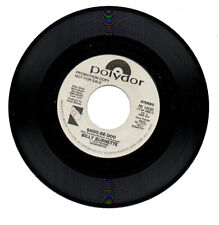
BILLY BURNETTE 45 RPM Promo Record "SHOO-BE-DOO" 1978 Rock Unplayed MINT
$6.70


 Threaded Mode