
| |
|
|||||||
 |
|
|
Thread Tools | Display Modes |
|
#16
 07-20-2004, 03:22 PM
|
||||
|
||||

Quote:
 Dean held the same point of view as John Kerry, that the only time we should go in is when all diplomatic relations fail. I can quote the man if you'd like. He then went on to say in the months leading up to the war that if Iraq does not prove that they have no weapons, we need to go in. Also, just like Kerry, Dean said that we need to stay in Iraq now that we invaded. Only when it turned into the major f*ck up that it is did Dean change his mind and started to become the "anti-war candidate." In all actuality, he was never the "anti-war candidate," Dennis Kucinish was (and still is), along with Braun. Dean pulled the wool over the eyes of many, but he sure as hell didn't when it came to me. That's why I never supported the guy; he was the king of back-talk.
__________________
|
|
#17
07-20-2004, 03:49 PM
|
|||
|
|||
|
Quote:
Don't you think it's time Kerry admitted he fooked up in a major way in voting for this war? He just seems to want his cake and eat it too. It's a loser strategy, and it will keep the White House in Republican hands. Mark my words.
|
|
#18
07-20-2004, 03:54 PM
|
||||
|
||||
|
Quote:
 He did the same thing Kerry did, only in a shorter time span. He did the same thing Kerry did, only in a shorter time span.Of course I want Kerry to admit it, but I'm not his strategist or his campaign manager.
__________________
|
|
#19
07-20-2004, 05:49 PM
|
||||
|
||||
|
Quote:
|
|
#20
07-20-2004, 07:18 PM
|
||||
|
||||
|
Quote:

|
|
#21
07-20-2004, 07:55 PM
|
|||
|
|||
|
Quote:
He did the people of Massachusetts a disservice, and now he's handing them them another loser campaign.
|
|
#22
07-20-2004, 10:26 PM
|
||||
|
||||
|
Quote:
"Kerry made a political bet in voting for the war because he thought that's what the public wanted and he knew he'd be running for president." So which is it? How's your cake? Are you eating too? By the way, "I'm guessing" that the moon is blue. What do you think?
|
|
#23
07-21-2004, 12:20 AM
|
||||
|
||||
|
Quote:

|
|
#24
07-21-2004, 08:03 AM
|
|||
|
|||
|
Quote:
You gotta explain to me what your point is here. I said he thought that's what the public wanted. But he should have been listening to the people of Massachusetts, the people he represents, rather than playing politics. I don't see what's so hard to get about that. You are so blinded by partisanship you can't even admit your man made a HUUUUUUGE mistake in voting for a war that has killed thousands of people needlessly. Yet you are so quick to blast the Bush administration. Aren't they really partners in the killing? A vote for Kerry is a vote for Bush.
|
|
#25
07-21-2004, 08:22 AM
|
||||
|
||||
|
Quote:

__________________
|
|
#26
07-21-2004, 09:07 PM
|
||||
|
||||
|
http://www.guardian.co.uk/usa/story/...264765,00.html
How has the US been spending other people's billions? Simon Tisdall Tuesday July 20, 2004 The Guardian Henry Waxman is an awkward customer. For 30 years, this California congressman has probed, badgered and embarrassed US administrations of every hue. As the senior Democrat on the House of Representatives' government reform committee, Congress's principal standing investigative panel, he is a difficult man to ignore. Right now, Mr Waxman has a question on Iraq. In fact, he has several - and in typically robust fashion, he is demanding answers. What he wants to know is whether the Bush administration has been fiddling with Iraq's oil revenues. He wrote to the Republican chairman of the reform committee on July 9, suggesting there was a serious case to answer. Subpoenas should be issued, he said, "to investigate potential mismanagement of the Development Fund for Iraq (DFI) by the United States". The DFI was set up after last year's invasion as the depository for Iraq's multi-billion-dollar oil revenues and was administered, until June 28, by the US-led Coalition Provisional Authority (CPA) - with notional UN oversight. In particular, Mr Waxman is curious about "the [Bush] administration's last-minute 'draw-down' of billions of dollars from the DFI for unspecified expenses" prior to last month's transfer of sovereignty. "For example, $1bn [about £550m] was withdrawn from the DFI during the last month of the CPA's existence for unspecified 'security' purposes." The administration provided no information about how these funds would be spent, Mr Waxman says, and has yet to do so. He is concerned about apparent attempts by the then CPA chief, Paul Bremer, to mandate and direct the spending of a further $4.6bn in Iraqi oil funds after the handover. He is also exercised by the results of a belated audit of the DFI's accounts that concluded they were "open to fraudulent acts" and lacked "transparency". In all, the CPA earmarked more than $6bn of Iraqi funds in the last two months of its existence. He wants to know whether CPA officials obstructed the auditors, KPMG, who were employed by the UN-created International Advisory and Monitoring Board (IAMB). And he also asks why the White House has "failed to comply with numerous IAMB requests [for information about] payments of approximately $1.5bn in DFI funds to Halliburton" - the Texas-based oil services company formerly headed by the vice-president, Dick Cheney. Mr Waxman is not alone in asking questions. In April this year, the chairman of the IAMB, Jean-Pierre Halbwachs, wrote to Mr Bremer saying the awarding of three contracts to Halliburton without a competitive bidding process was "a source of concern". His letter appears to have had little effect. The IAMB is now reviewing the CPA's overall conduct and must decide whether a full investigation is necessary. Given the problems over alleged misappropriation and fraud that engulfed the UN's oil-for-food programme in Iraq from 1997 to 2003, and which are now under investigation, swift, rigorous action in this instance may also be deemed essential. Officials from Congress's financial watchdog, the general accounting office, have pointed out meanwhile that while the CPA was keen to appropriate Iraqi oil revenues, it was much more reluctant to spend bilateral US aid funds. Nearly all of the $20bn in the DFI was spent or allocated by June 28 - but only 2% of the $18.4bn promised by the US for reconstruction was actually spent. According to White House figures, for example, and despite all the rhetoric about building a new Iraq, not a cent of America's own money had been spent on construction, healthcare, sanitation and water projects as of last month. Last month, Iraq Revenue Watch, part of the Soros Foundations network, accused the CPA of "committing billions of dollars to ill-conceived projects" using Iraqi rather than US funds, effectively pre-empting budgetary decisions that should have been left to the interim Iraqi authority. This is a charge also voiced by senior Iraqi officials in Baghdad, quoted anonymously this month by the Washington Post; and, intriguingly, by British government aid officials who reportedly blocked spending projects proposed by Mr Bremer in the dying days of the CPA. But at Westminster, only the Liberal Democrats have formally called for an investigation. Such matters are plainly extremely sensitive as the US presidential election approaches - especially for George Bush and Mr Cheney. In this context, two facts may be of interest: Halliburton was the largest single recipient of Iraqi oil funds during the occupation, according to the Army Corps of Engineers' figures released last month. And among US politicians, according to the Center for Public Integrity, Mr Bush has been the largest single recipient of US oil and gas industry campaign contributions since 1998 - his total stands at $1,724,579.
|
|
#27
07-21-2004, 10:33 PM
|
||||
|
||||
|
This isn't surprising, Chris. In last weeks issue of The Nation, there was a great cover story called "The Rough Guide To Baghdad." It talked about how everything has gone to **** because of the American occupation and how Baghdad is, basically, a slum. The company that was given contracts to clean up Iraq already cashed the check over a year ago, but as of yet, they haven't done ONE THING. The economy is nonexistant because there's no water, the streets are filled with sewage, the hospitals don't have any supplies; it's awful.
I subscribe to them, so I'll be able to go get the article on theri site and post it; it's fascinating.
__________________
|
|
#28
07-21-2004, 10:47 PM
|
||||
|
||||
|
Here's the article. I can't link to it because you have to be a subscriber to use the site.
 Originally published in "The Nation": The Rough Guide to Baghdad by Christian Parenti A young white South African pilot leans in the cockpit doorway of a small NGO-chartered prop plane and gives his ten passengers the pre-flight pep talk: "At 10,000 above Baghdad International Airport, we will begin our descent in a spiral dive. This avoids surface-to-air missiles and ground fire, we hope. But don't worry, the maneuver is well within the technical capacities of the machine. Enjoy the flight to Baghdad." The flight is fine--but the dive is fast, steep and scary. Since April most roads into the capital of Iraq have been closed by sporadic combat and marauding gangs of looters. Westerners are special targets. Some elements in the resistance are said to pay $20,000 a head for hostages. The only truly open road is the heavily patrolled route north through Kurdistan to Turkey or Iran. So now journalists fly in. It's the "safe" way to reach this politically diseased metropolis, which after fourteen months of US occupation and alleged reconstruction is tormented by a fever of violence, social breakdown, administrative anarchy and economic decline. The crisis now seems to feed on itself in an epidemiological fashion, with symptoms reinforcing root causes in a downward spiral. Lack of security--the central issue--means lack of electricity, which means no work, which means more violence, and so on. In response, Iraqis either cling to a blind faith that America will sort things out, or they turn to tradition, self-organization, Islam and armed resistance. At the 1970s-style passenger terminal where we land, the long hallways and lounges are empty. Outside I find some Kroll security men headed to Baghdad and bum a ride. The twenty-kilometer dash from here to the city is called "RPG alley." This, despite the airport being contained within a huge US military base. "This road is ridiculous," says the flak-jacketed Brit riding shotgun. He chambers a round in his short Heckler and Koch assault rifle. Recent ambushes have hit several convoys here. The only one that made the news ended with four more dead mercenaries from Blackwater USA, their SUV in flames. "The First Cav should have checkpoints every few clicks. And they should clear all surrounding areas," says the Brit. "I have no idea how they think this is supposed to work without a secure airport." June was a bad month. The malady of occupation was in full recrudescence: car bombs killing scores each week, assassins culling the political class, routine but underreported sabotage. In the slums of east Baghdad--Sadr City--the newly arrived First Cavalry Division has almost nightly shootouts with Muqtada al-Sadr's Jeshi Mahdi, or Mahdi Army. Ten days to sovereignty--the city waits. I awake, as usual, in a sweat to the sound of a rumbling boom. The big explosions are usually in the morning. This one sounds close. "Car bomb!" yells a colleague down the hall. Four of us are bivouacked in a cheap, almost empty Baghdad hotel run by a friendly but thuggish man from Falluja. The accommodations--along with our recently grown beards, dark tans, locally purchased cloths and preference for beat-up old cars--are all part of a low-tech "security strategy." If most Western journalists live in walled compounds with armed guards and still get kidnapped or shot up, we figure, do the opposite. Go local, blend in, try to pass as Iraqi, to the extent we are able. "Abu Talat called," says my colleague. "The bomb was right by where his wife works. He's headed over. We're outta here in five minutes." At al-Rashid Street, in old Baghdad, blocks from the Central Bank of Iraq, we find the aftermath. It wasn't a car bomb, just a big IED (improvised explosive device) set to hit a money truck. But the timing was off by a few seconds--commuters took the blast instead. Four are wounded, one may have already died. Iraqi cops and bank security men with Kalashnikovs mill around a shattered wall and some twisted metal gates, while two Arab TV crews shoot video. Thirty feet away sits a victim's shattered car. Looters are already at work stripping the salvageable parts. The cops pay no attention. Thanks in part to police inaction, kidnapping, carjacking and murder have imposed an informal dusk-to-dawn curfew in many parts of this city. The director of the Baghdad morgue tells me that he sees an average of at least 600 unsolved murders every month, adding, "There are many more cases we don't receive." In a city of roughly 4 million, this translates into a crime rate about ten or fifteen times higher than the most violent cities in America--and this has serious economic consequences. "Little things create big economic problems," explains Asaad Witwit, an elegant but casual Iraqi burgher, who owns four factories, three of which are currently closed. "Security is the biggest problem." We're meeting in the riverfront offices of the Iraqi Federation of Industry, a lobby group for private-sector manufacturers. Witwit is a leading board member. As we speak in English, three of his colleagues are commiserating and working the phones in fast, angry Arabic. The federation just bought a new truck-sized generator for its building, but the machine was stolen before it was even delivered. (US contractors deal with such problems by giving their mobile phone numbers to local sheiks so they can have first dibs on buying back their gear.) Iraq's badly battered infrastructure is another problem, explains Witwit. "For example, you cannot make paint if you do not have clean water. Salts and minerals in the water ruin the paint. Or to make ice, or to can food, or process meat, you need clean water. We don't have that," he says philosophically. Behind him his colleagues rage on in Arabic about the "son of a whore" who sold them the generator and then most likely stole it back himself. Then there are the cheap imports that have flooded the country since the US invasion. Witwit's sole working factory is a plastics plant that makes thermoses and coolers, but he has laid off most of his thirty employees because Chinese and Iranian imports are driving down prices. To upgrade and retool requires capital. "We need loan programs, investment, but the Americans do nothing. They only talk about the free market." IIraq's social geography were reduced to political antipodes, one pole would be the fortified and manicured American-occupied Green Zone: a huge palace and office complex built by Saddam. The other pole would be the fetid, baking eastern Baghdad slum of Sadr City, also known as Al Thawra (the revolution). To enter the Green Zone is to consume a thousand-milligram tablet of denial washed down with fresh-squeezed orange juice. The air conditioning here is superb; everyone looks happy. David Bourne is working his laptop at the Iraqi Business Center, an empty, glass-walled subsection of the Convention Center. Bourne, wearing a crisp media-blue oxford shirt and dark slacks, exudes Ivy League confidence. He is here to do good and to do well, at once. "When we get the business center running, local subcontractors will be able to network and learn about bidding," he explains, as if the occupation weren't already fourteen months old. "A lot of the reconstruction hasn't begun yet, and the center will facilitate capacity-building with local firms." He pauses and then adds with considered honesty: "A lot of Iraqis think it's just about who you know. But government-funded work requires competitive bidding, transparency, quality control, all that." He won't comment on how Halliburton and Bechtel got their huge slices of the $18.5 billion reconstruction pie. But that's already a matter of public record. Bechtel got the first installment of its no-bid billion-dollar contract on April 17, 2003, after secretive dealings with the US Agency for International Development. Halliburton also had an inside track. On the other side of a glass wall, a uniformed janitor pushes a Zamboni-like buffer across a shining expanse of floor. Iraq seems a thousand miles away. Now unplug from the Matrix, and the temperature suddenly soars to a brutal 115 Fahrenheit. The air reeks of sewage; hot, furnace-like gusts blow grit into your eyes. An urbanized plain of misery and squalor opens before you: the hyperviolent Sadr City. The wide boulevards, laid down in the late 1950s by the optimistic planners of the Qasim regime, are now flooded for blocks at a stretch with ankle-deep pools of green, algae-rich sewage. Heaps of garbage smolder on the medians and in empty lots. Pirated electrical wires crisscross dense side streets of mud-brick homes. Small flocks of mangy goats and sheep, shepherded by women in flowing black abayas, forage in the trash. The lumpen Shiites who live here are derided by Baghdad's more urbane Sunnis as sharugees--an insulting term meaning "easterners" but connoting ignorance and filth. Like the N-word among some African-Americans, streetwise young Shiites have defiantly appropriated sharugee for their own use. The sewage problem in Sadr City is not merely unsightly; it is a major health threat. As the head of the local public works department, or Baladia, explained it, the sewers here were never great, but the constant backup and nauseating overflow is a new problem. First there was bomb damage and then, as garbage trucks were looted or destroyed, trash clogged the sewers. Most of the special trucks needed to clear the backed-up lines were also looted. The last four were recently commandeered by US contractors for use all over Baghdad. Bechtel has the $1.8 billion contract to rebuild Iraq's water, sewage and electrical systems. Electrical clearance work and the rebuilding of water systems is also being carried out by a company called Washington Group International. Local engineers say the firm has done next to nothing. At Sadr City's Al Jawadir hospital the halls are crowded with worried-looking men and women. An emaciated, greenish man is wheeled by on a gurney. Here one clearly sees the social impact of the sewer problem and the general chaos of which it is a subset. The hospital director, Dr. Qasim al-Nuwesri, explains that the hospital serves at least a million and a half people and sees 3,000 patients a day, but suffers for lack of adequate medicine, equipment, clean water and security. "We have to get clean water shipped in," he says. "A German NGO delivers it in a tanker truck." Typhoid is rampant, he adds, and an outbreak of hepatitis E is gathering momentum, with forty new cases a week. "The coalition promises money and supplies, but there is never enough," says the director. "I am forced to reuse needles and deny people anesthesia. We only do serious emergency surgeries." Upstairs on one of the wards we meet a 25-year-old internist named Ali Kadhem. Like many doctors, he speaks English. His face is open and boyishly innocent, and he possesses an understated yet intense personal charisma. When he talks, the other doctors and orderlies listen and watch. Ali says gunmen enter the hospital demanding special treatment for relatives. Two weeks ago an addict pulled a pistol on him and stole morphine. One doctor was shot right in front of the hospital by thieves. He says that since April, US troops have raided the wards on three different occasions, looking for wounded Jeshi Mahdi fighters. "They interrogated the wounded and searched in a very rough way and tore down religious posters," says the young physician. Several wounded Mahdi men, as well as civilians, have fled the hospital in fear of the raids. "I know that some of these people died because they hid in their homes and we could not treat them," says Ali. "We could have saved them. The cause of all these problems is the Americans. We need for them to go." The Mahdi's fighting in Karbala and Najaf, provoked in large part by US assaults, alienated huge swaths of the mainstream Shiite community--particularly the merchant class that depends on pilgrim traffic to the holy cities. But spend a day or two in Al Thawra and it's not hard to understand why people follow Muqtada al-Sadr. He is a junior religious scholar, unlike his father, who was an ayatollah, but Muqtada's leadership is primarily political, and his following, likewise, is Shiite but religiously diverse. His power is rooted in his willingness to oppose the occupation openly, just as his martyred father opposed Saddam. More practically, he is followed because the branches of his organization deliver a slim modicum of order and stability to a few parts of Baghdad and cities farther south. In front of the hospital a man named Uda Mohame explains the logic: "Everyone cooperates with the Jeshi Mahdi. There are no police here, no government. The Mahdi direct traffic, they fix things, they do all the work." At the Sadr office on one of Al Thawra's main streets, I try to meet Muqtada's local representative, a 29-year-old sheik named Hassan Edhary, but he is on the run. The First Cav wants him, dead or alive. His two predecessors are already in Abu Ghraib. A few weeks ago, US tanks blew up this office. Reconstruction started the next day at dawn. "Little boys cleaned the bricks while men rebuilt," explains a local man named Samir. Now the walled compound, draped in black banners mourning the dead and topped with big fluttering green-and-black flags, looks as good as new. The men here are all Mahdi but they are unarmed by day. There can be no formal interviews, I am told, without the sheik's permission. For the better part of a week I return again and again looking for Sheik Edhary, but he's still on the lam. As I am leaving the office after one failed attempt, a young Mahdi man says to me, "Look, the Americans attack us. That is why we fight. We have a right to respond." It's late afternoon, another trip to Sadr City. One of my colleagues from the dive hotel and our translator roll out determined to find the Mahdi in action. They're out here somewhere; we've already seen a US patrol of two tanks and three armored Humvees. On one of the slum's main thoroughfares, al-Radhewi Street, are several walls marked with a message in English. Big block letters read Vietnam Street. Farther on, a wall bears a crudely painted mural depicting a modified version of an infamous Abu Ghraib torture photo. It is the prisoner in the hood and cloak standing on a box, arms outstretched, electrical wires dangling from his limbs. Next to him in the mural is the Statue of Liberty, but in place of her torch she holds the lever of an electrical switch connected to the wires. Below is scrawled: The Freedom Form George Bosh. We snap photos and move on. Then, before we find them, the Jeshi Mahdi find us. Two men in a sedan are suddenly next to us. "Pull over!" Now they are at our doors, hands on the pistols in their waistbands. "Who are you? What are you doing here? Why are you photographing things?" "Sahafee canadee, sahafee canadee!" I show them my counterfeit Canadian press pass. Our translator is talking fast, explaining that we are anti-occupation, that we are trying to show the truth. He's naming his family, naming sheiks, naming Sadr men who are old friends. The undercover Mahdi fire back questions and suggest that we get out of the car. We show them the digital photos of the graffiti and offer to erase all the shots, but we ignore their request to get out. More fast Arabic goes on. Finally the Mahdi begin to relax. "This is called Vietnam Street because this is where we kill Americans," says one of them. "We are in a war with them. That is why we stopped you. You understand? We have to protect our people." The man in charge adjusts his pistol one more time, looks around, then says, "You can go." We thank them profusely and then hit the gas. The hard spike of adrenaline in my chest releases in a warm wash of endorphins. The next day I head back looking for Sheik Edhary, but he's still underground. On our way a pickup truck just ahead of us abruptly reverses into our taxicab with a slam, then does a fast three-point turn over the median. Suddenly everyone is backing up and turning around fast. "Fighting ahead. We have to go!" says Hussein, a translator, journalist and computer hacker who hangs out with our ragtag crew. The next day Al Jazeera reports "around twenty Iraqi resistance fighters" killed or wounded in clashes all over Sadr City. At the offices of the District Advisory Council, a body "elected" in a hasty, poorly publicized, US-managed referendum, there's more evidence of war. "Sorry, man. Nobody around. We're just here to secure the building," says Staff Sgt. Josh York. The twenty-five-member DAC dispersed several weeks ago after their leader was blown away in a political hit. Now the council's compound is a small US firebase. "They've been hitting us with RPGs every night," says Ser-geant York. "No casualties yet, but last night we took eleven RPGs, one at a time all through the night." The young soldier doesn't look nervous or afraid, just beat-down tired. Finally Sheik Edhary surfaces; perhaps this has something to do with the Americans' new offer to allow Sadr's organization into electoral politics. (The Sadr people are still quite cagey about what they will do on that front.) Edhary grants an interview, but mostly we just sit and watch him in action, Hussein quietly translating the conversations around us. Edhary wears a white turban and flowing robes. His beard is full but short, like Muqtada's. He is dark, intense and very handsome. I can't help thinking that Edhary looks like a cinematically improved version of the real Muqtada, who is stooped, pudgy and frowning. A stream of supplicants files through Edhary's little office, asking for advice, money and letters. One lives in an IDP (internally displaced people) camp and has no roof. Can the organization help? Edhary says, "I don't have enough people to go investigate your claim. But if you can find a religious sheik in your area to write a letter on your behalf, then come back." A young doctor explains that a group of medical workers has some money and wants to open a free or low-cost pharmacy to serve the people. Can the office contribute some money? The sheik leans close and plays with his string of black prayer beads as the young man talks. Finally, he tells the doctor that Hussein, our hacker pal, can help the clinic with its computers. Hussein and the doctor exchange numbers. Then come a few high-tension cell-phone calls. Some sweaty Mahdi men rush in. They've just busted looters with four stolen trucks full of sugar. It turns out the trucks belong to a European NGO, not the government or some rich company. The sheik wants the vehicles and sugar returned, via the police, to the NGO. "We have the trucks in storage. Can we turn them over tomorrow?" asks the rotund Mahdi man in charge of the bust. He's wearing a dirty football jersey. "I am your servant. I have given my whole life to the religion, but I really cannot do this tonight." Someone else bends over and whispers to the sheik. Edhary looks worried. There's more whispering. Edhary leans away from the men at his desk and snaps taut a section of his black prayer beads, then counts the little glass balls. He is "asking God" for advice. An even bead count means yes; odd means no. "No! No! Absolutely not," the sheik bounces up from the desk, his outer black robe slipping from one shoulder. He's addressing the sweaty man. "The trucks must be returned tonight. If the trucks do not move now we will be blamed. Either you do it now, or just go and don't do it at all. I will find someone else." The sheik is electric with stress but dignified. "I am your servant, as you wish," says the Mahdi guy, but he looks pissed as he and his posse sweep out to deal with the trucks. If there is anything like "progress" in Iraq it takes place here, under the radar, in the rubble of occupation. Sadr's followers, despite many faults, including thuggishness and misogyny, are central to creating what order there is in this ravaged ghetto. On the last Friday before the handover I go back to Vietnam Street for a mass prayer. This time, the Jeshi Mahdi are out in full force, armed with pistols and AK-47s. Line after line of them are politely and efficiently searching a crowd of more than 10,000 people who have come to lay their prayer mats in the street, worship and hear a political sermon. The Mahdi search me several times, and I am ushered to the front, walking barefoot across the solid field of prayer mats; some are mere towels, others are intricate, colorful carpets. The sermon, by a Sadr sheik named Ous al-Khafji, attacks the occupation but calls for calm. The Mahdi have declared a cease-fire. Under a blazing sun, with squads of men and boys spraying rose water on the congregants, the crowd chants, "Ya Allah, Ya Ali, Ya Husein," meaning with Allah, etc., then "Muqtada! Muqtada! Muqtada!" At the end the worshipers all shake hands, then disperse. Later I am granted an interview with some Mahdi fighters. They make sure I can't see where I am headed as we drive deep into the side streets of Sadr City. Our interview takes place in an abandoned shop; there are three fighters, two of whom were jailed and tortured under Saddam. They repeat the party line about wanting peace but add, "If the Americans arrest people we will strike." One of them moves a tarp and reveals a huge 155-millimeter artillery shell and a long spool of wire. It's an IED. "If they attack, we have this rat poison, for the American rats," says the fighter pointing to the bomb. "But God willing, we will not be forced to use it." Time for me to go. Clearly "sovereignty" remains fragmented, localized, ephemeral and mostly imaginary. Neither Iraqis nor the Americans have control. The new Prime Minister, Iyad Allawi, is threatening martial law. How he might impose this and how it would differ from the current methods of occupation are difficult to envision. In the new Iraq, only chaos is truly sovereign.
__________________
|
|
#30
07-23-2004, 10:34 AM
|
||||
|
||||
|
Quote:
__________________
|
|
|
|

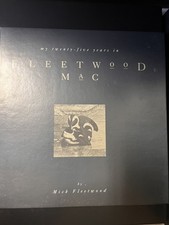
My 25 Years in Fleetwood Mac by Mick Fleetwood Hardcover Print 1992 CD included
$8.50
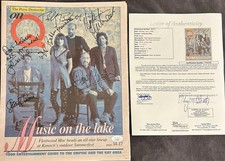
Fleetwood Mac FULLY SIGNED On Q Newspaper JSA LOA McVie Mick Fleetwood Autograph
$399.99
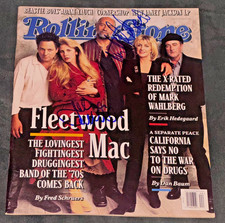
Signed John McVie Mick Fleetwood Mac Autographed Rolling Stone Magazine Auto PSA
$499.99
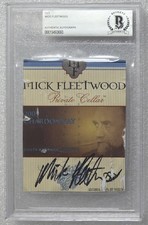
MICK FLEETWOOD SIGNED WINE LABEL BECKETT BAS COA AUTOGRAPHED SLABBED MAC SINGER
$235.00

Fleetwood Mac ~ Mick Fleetwood / John McVie Signed 11x14 Photo Page with JSA COA
$299.94


 Linear Mode

