
| |
|
|||||||
|
|
Thread Tools | Display Modes |
|
#1
 11-26-2003, 01:34 PM
|
||||
|
||||
 Semi-off/semi-on topic article re: Sales of Warner Bros. Music
I don't really know what this will mean, but I thought I'd post it anyway.
International Herald Tribune November 25, 2003 Warner Music is sold Edgar Bronfman Jr. is looking for a hit by David D. Kirkpatrick and Andrew Ross Sorkin Time Warner agreed Monday to sell its Warner Music business to Edgar Bronfman Jr. and a group of investors led by Thomas H.Lee Partners for about $2.6 billion in cash. The purchase creates one of the world's largest independent music companies, home to recording artists like Madonna, REM and Fleetwood Mac among many others. Bronfman, a onetime songwriter for Celine Dion and others, will become the company's top executive. Bronfman, who has lived in the shadow of a financially disastrous decision to sell his family's Seagram's liquor empire for shares of the French utility-turned-media company Vivendi, is expected to contribute about $250 million to the deal, buying himself a chance to repair his damaged reputation. Bronfman said Monday in a statement about the deal, ''we have great faith'' in the company's ''potential for growth as an independent company and in the long-term opportunities of this industry.'' But the deal's success hinges in large part on Bronfman's contrarian conviction that the embattled music industry can tame online piracy and reverse a three-year sales slump. Like Bronfman's deal with Vivendi, the acquisition of Warner Music is in part another bet on an untested new Internet business, the sale of music online. This time, however, he has assembled a well-healed cadre of investors that share his vision. Despite the disastrous results of the Vivendi deal, which nearly collapsed and took his family's fortunes with it, Bronfman has told friends he thinks he has nothing to prove. ''The only time I hear Edgar get upset is when he reads that this is about redemption,'' said Richard Snyder, former chief executive of Simon & Schuster and a Bronfman friend and adviser. ''He feels: 'This is my next stage. I am 48. This is what I am going to do with the rest of my life. I don't want to sit home and have a yacht and do the things that wealthy people do. I want to work.''' Snyder said. Yet other friends and some of his backers said that Bronfman's drive in pursuit of the deal _ and his pledging an additional $50 million of his own money during a frenzied final weekend of negotiations _ was hard to understand as anything but a quest for vindication. ''He is not working around the clock because he needs the money,'' a member of the investor consortium said. ''This is about him.'' In wooing the investors, Bronfman argued that online music piracy was already abating thanks to lawsuits by the music industry and legal online music sales by companies like Apple Computer and Wal-Mart Stores. But some investors were not as sanguine about the industry's prospects, particularly at a cost of $2.6 billion. On Saturday afternoon, at least one investor who was expected to take part in the consortium, the media entrepreneur Haim Saban, backed out, people involved in the bid said. But by the end of the night the investor group had lured Saban back for a much lower stake. Others involved in the bid defended the deal, saying that cost-cutting alone would increase profits at Warner Music. But some executives of the music unit wonder how much fat remains in its operations. Warner Music has laid off more than 2,000 of its 6,500 employees over the past three years. The entertainment business has always been Bronfman's passion. Taking a cue from his father, Edgar Sr., who once made a run at control of MGM over his own father's objections, Edgar Jr. skipped college to make movies. He produced films including ''The Bunker,'' a war film, and ''The Border,'' starring Jack Nicholson. He wrote songs including ''To Love You More,'' recorded by Ms. Dion, and ''Whisper in the Dark'' sung by Dionne Warwick. He tried his hand at producing for Broadway, too, and recently returned to it. He is currently producing a musical, ''Never Gonna Dance,'' a stage version of the Fred Astaire and Ginger Rogers film ''Swingtime.'' His earlier career as a producer never paid off and after a few years in Hollywood he took a job with his father at Seagram in 1982. In 1993 Edgar Jr. encouraged his father to began buying shares in Time Warner as a possible acquisition target. In 1995, a year after becoming chief executive of Seagram, he overruled the objections of Charles Bronfman, his uncle, to sell Seagram's stake in the chemical giant DuPont and instead acquired control of the entertainment businesses of MCA, the parent company of Universal Studios, for $5.7 billion. Bronfman's tenure drew mixed reviews from investors. In the six years after his appointment as chief executive, Seagram's shares consistently lagged the performance of Time Warner and other major entertainment stocks. But they doubled, outperforming DuPont. And Bronfman endeared himself to executives who worked for him. ''He did a sensational job with Universal and the success we have today is due to his leadership,'' said Ron Meyer, the president and chief operating officer Bronfman hired to run Universal's film and television studios. ''If he winds up with Warner Music, I have no doubt that he will do a superb job with it.'' Executives at Universal Music say Bronfman astutely overruled opposition within his family and backed them in the acquisition of the rap label Interscope, which became a steady source of hits. ''He is a tough guy, and I am glad he got this,'' Doug Morris, chief executive of Universal Music, said. Executives credit Bronfman with helping to engineer the acquisition of PolyGram for $10.4 billion in 1998, making Universal by far the largest of the five major music companies. But the purchase came near the top of the market. The music industry soon found itself troubled by the free downloading of music from the Internet, and what was a $40-billion-a-year global business is expected to fall to about $30 billion this year. Bronfman blundered in 2000, when, again over the opposition of his uncle, he agreed to sell Seagram to the French executive Jean-Marie Messier for $34 billion in Vivendi stock. Messier was bent on transforming Vivendi into a multimedia powerhouse that would transmit songs, movies and video games over mobile phones and other devices. His vision of the future proved wildly premature, and the debts from his acquisitions brought the company to the brink of bankruptcy. The Bronfmans' stake in Seagram was worth $6.8 billion at the time of the sale, but the value of Vivendi shares has fallen by more than 60 percent since then. It is impossible to know how much Edgar Bronfman Jr. lost. Early in 2002, Bronfman, realizing too late that Messier's spending spree had mired the company in debt, tried to oust Messier. The first attempt failed, and Bronfman later blamed French anti-Americanism and anti-Semitism for the resistance. After Vivendi's close brush with bankruptcy and Messier's departure in 2002, Bronfman was roundly derided on Wall Street and in the press. ''He took a beating _ some of it he deserved, some of it he didn't,'' Snyder said. Bronfman began plotting his return to the business soon after his departure, taking a leave from Vivendi's board to court backers for a bid in the auction of its Universal entertainment businesses. When the Time Warner deal closes, Bronfman will have another chance to make good on a pledge he made when he became chief executive of Seagram in 1994: ''I am not going to go down in history as the one Bronfman'' who lost the family fortune. © 2003 Copyright International Herald Tribune. http://www.iht.com
__________________
madness fades 
|
| . |
|
|

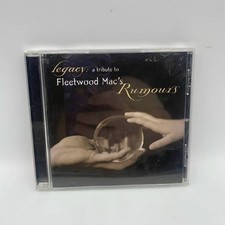
Legacy A Tribute to Fleetwood Mac's Rumours CD TESTED AND WORKS
$1.99
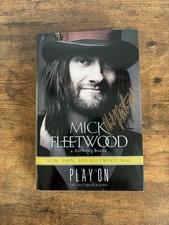
MICK FLEETWOOD Signed Autograph Book "Play On" .
$88.99
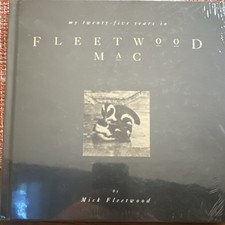
Sealed Mick Fleetwood My Twenty-Five Years in Fleetwood Mac HC 1992 Ltd Hyperion
$99.00
MICK FLEETWOOD SIGNED WINE LABEL BECKETT BAS COA AUTOGRAPHED SLABBED MAC SINGER
$235.00

Pristine Pair 12" Mick Fleetwood Mac Custom Remo Autograph Drumheads MF Logo NOS
$200.00


 Threaded Mode