
| |
|
|||||||
|
|
Thread Tools | Display Modes |
|
#1
 03-23-2016, 12:12 AM
|
|||
|
|||
 FM Compared to the Minnesota Timberwolves
Feelings Aren’t Numbers: Don’t Stop Thinking About Tomorrow
By Steve McPherson | 1500 ESPN Twin Cities March 21, 2016 http://www.1500espn.com/wolves-2/201...bout-tomorrow/ When I was barely a basketball writer at all, I spent a lot of time drawing parallels between my new obsession with the game and my old obsession, music. LeBron James as Eric Clapton; Kobe as Stevie Ray Vaughan to Jordan’s Jimi Hendrix; the San Antonio Spurs as Steely Dan. I always saw this not as a way to necessarily better understand either the game or the music, but as a way to better understand how we process the things we love or follow or obsess about. It works best with individual players and solo artists, but there’s a bit of stumbling block when it comes to teams and bands because teams are constantly changing from year to year while bands, generally speaking, are models of continuity. But then there’s Fleetwood Mac, and there are the Minnesota Timberwolves. Formed in 1967 in England, Fleetwood Mac began when guitarist and singer Peter Green left John Mayall’s Bluesbreakers and took with him Mayall’s rhythm section of Mick Fleetwood and John McVie — “Fleetwood Mac” was originally the name of an instrumental by Green and the band was actually called Peter Green’s Fleetwood Mac. With the mercurial and wild-haired Jeremy Spencer on slide guitar, the band recorded two (criminally underrated) albums of British blues, Fleetwood Mac and Mr. Wonderful. Now, I’ve long held the belief that if you’re going to do the basketball-music thing, point guards should be drummers. They are above all responsible for setting pace, tone and dynamic, and can do more than most any other instrument to push the music in different directions. So let’s take a 21-year-old but already professionally seasoned Ricky Rubio in his rookie year of 2011-12 and pair him with Mick Fleetwood, another seasoned pro at the ripe age of 20 in 1967. Kevin Love — beginning to come into his own under Rick Adelman after toiling as a mere sideman under Randy Wittman and Kurt Rambis — can be our Peter Green. For continuity’s sake with the current team and because no one truly appreciates bassists, Nikola Pekovic can be John McVie. And Michael Beasley will be Jeremy Spencer for reasons that will become entirely obvious shortly. This initial version of Fleetwood Mac was awesome and reasonably if not terrifically popular, while the Wolves under Adelman for their first two years achieved something like critical acclaim for the brief moments when all of Rubio, Love and Pekovic could share the court and showed off the potential displayed therein. Before releasing their third album, The Pious Bird of Good Omen, Fleetwood Mac added guitarist Danny Kirwan, while prior to their third season under Adelman, the Wolves added shooting guard Kevin Martin. Fleetwood Mac released their first number one single, “Albatross” and the Wolves were way way better than you remember, boasting one of the league’s best starting lineups to go along with one of the league’s worst benches and a coach dealing with personal issues off the court and the impending end of his coaching career on the court. The team and the band each contained the seeds of their own destruction. While on tour, Jeremy Spencer told the band he was going out to “get a magazine” and never came back. They found him a few days later and learned he had joined a cult. (I told you the Beasley thing would connect.) Peter Green took a hit of LSD at a commune in Germany and lost his mind, eventually being diagnosed with schizophrenia but not before he threatened his manager at gunpoint when the manager refused to stop sending him royalty checks. (In this way, he was maybe a little different from Kevin Love.) It got dark and weird for the band, basically, including a ridiculous stint in 1974 when their manager, Clifford Davis, claimed ownership of the name “Fleetwood Mac” and put together a tour with an ENTIRELY DIFFERENT group of musicians billed as Fleetwood Mac. But after the band moved to Los Angeles from England — consisting at this point of John McVie, his wife Christine McVie, Mick Fleetwood and guitarist Bob Welch (Thad Young, for our purposes) — they found their new franchise cornerstones, their number one draft picks in Lindsey Buckingham and Stevie Nicks. This was the beginning of Fleetwood Mac as chart-topping monsters of pop mastercraft, a completely different version of the band from the one Peter Green started a decade earlier and ultimately, geometrically more successful. The crux of this comparison to me is the idea that a group — whether team, band or something else — can be amazing or incredible in some ways and yet still limited by fit, personality or things completely outside of their control. The original Fleetwood Mac was a focused dart of pure British blues. Their greatest strength was in their directness and simplicity, in Peter Green’s restrained but often vicious guitar work. But there was a ceiling there so long as they stuck to straight-ahead blues, and they bumped up against it as they expanded their palette with Then Play On. Add in the non-musical personal problems the members dealt with and the whole thing frayed and unraveled. But faced with simply breaking up or trying to recapture the success they’d already had, the remaining core of the band pivoted and reinvented themselves. Sports teams deal with this all the time, but are often loathe to completely abandon what worked before. We saw that with the Wolves in the wake of their 2004 run to the Western Conference Finals as they frittered away the final few years of Kevin Garnett’s first stint in Minnesota. At this point, the roster has had a near 100% turnover from Kevin Love’s final year with the Wolves, and with ownership an open question, the identity of the franchise itself could be changing in ways beyond the roster itself. So are Andrew Wiggins and Karl-Anthony Towns the Wolves’ Lindsey Buckingham and Stevie Nicks, respectively? Rubio can still be Mick Fleetwood, shepherding the team forward from behind the kit. Pekovic as McVie? OK, maybe not at this point. But Zach LaVine can be their third option, their Christine McVie. But if the Wolves are going to complete the equivalent of the transition from top-drawer blues band to world-bestriding pop juggernaut, it has to go beyond changing the players. Fans just have to hope they can make their Rumours without all the infighting, infidelity and drugs. That might finally make loving the Wolves fun. 
|
| . |
|
|

Fleetwood Mac Tour John McVie Bass Guitar Pick
$25.00
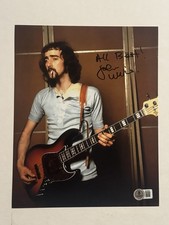
JOHN MCVIE HAND SIGNED 8x10 PHOTO AUTOGRAPHED FLEETWOOD MAC BASSIST RARE BAS COA
$127.49
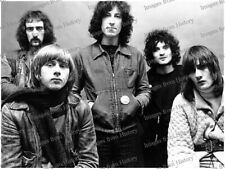
8x10 Print Fleetwood Mac Peter Green Mick Fleetwood John McVie 1969 #EFL
$13.99
Authentic Touring Fleetwood Mac John McVie Vintage Tour Guitar Pick
$119.10
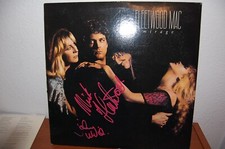
Fleetwood Mac: Mick Fleetwood and John McVie Autographed "Mirage" Album w COA
$200.00


 Threaded Mode